
Latest Products



Contact Us
- Gujiabu, Hujie Village, Zhangting Town, Yuyao City
- kiccy@yytonghui.com
- +8615267877473
The factory was established in 1989, and started to do export trade in 2010, mainly in Europe and the United States market.
The factory can design products and process them according to customers, our advantage is that we can do customized products according to customers' drawings and provide free samples. High quality products, no burrs, smooth surface, galvanized products all pass salt spray test.
Why Choose Us?
High quality: We take pride in the craftsmanship of our products and ensure that each one meets our strict standards for quality. High quality products, no burrs, smooth surface, galvanized products all pass salt spray test.
Professional Team: The factory was established in 1989, and started to do export trade in 2010. Dedicated to strict quality control and attentive customer service, our experienced staff is always available to discuss your requirements and ensure complete customer satisfaction.
High quality service: Professional and thoughtful after -sales team, let you worry about us after -sales Intimate service, strong after -sales team support.
Custom service: We can do customized products according to customers' drawings and provide free samples.
 Stainless Steel NPT Hydraulic Bulkhead
Size: NPT3/4. Threaded size can be customized. Material: stainless steel. Material can be stainless steel 304,316,316L. Perfect surface: smooth, no burrs , corrosion test can reach 48-96 hours.
Add to Inquiry NPT Hydraulic Bulkhead Fitting
Size: NPT3/4. Threaded size can be customized. Material: stainless steel. Material can be stainless steel 304,316,316L. Perfect surface: smooth, no burrs , corrosion test can reach 48-96 hours.
Add to Inquiry
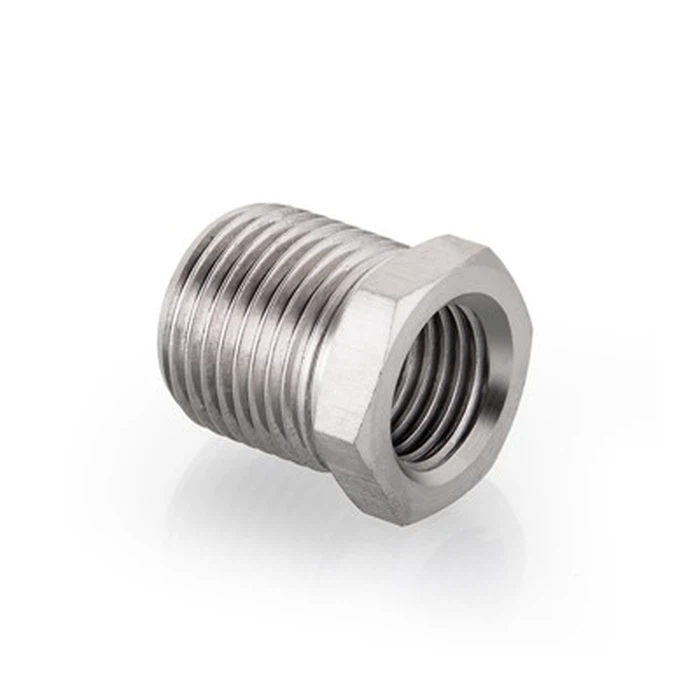
Stainless steel hydraulic bulkheads used in fluid and gas transfer through the bulkhead of a tank wall, panel, steel plate or any barrier that a hydraulic hose or pipe, or instrumentation tubing needs to egress. Like other hydraulic fittings, they connect two hoses or tubes in a fluid system. However, their unique difference is to provide the ability to run hydraulic hose through any barrier, often from inside a pressurized vessel or tank, out to normal atmospheric conditions connecting to other components in the hydraulic system.
Types of Carbon Steel Hydraulic Bulkheads
Carbon steel hydraulic bulkheads are available in various types. Some bulkheads are threaded while some are not. Before going for carbon steel hydraulic bulkheads, buyers should always consider whether it is threaded or not. Some popular types of carbon steel hydraulic bulkheads are like as follows:
Threaded carbon steel hydraulic bulkheads: Bulkheads are threaded both inside & outside and on both the ends. While buying carbon steel hydraulic bulkheads, it should be always considered whether it is threaded or not. Threaded fittings are divided into two types:
● Standard threaded carbon steel hydraulic bulkheads: These fittings are threaded on the outer side of both ends and inner side of the front end. However, the inner side of the opposite end is slip fitted.
● Double threaded carbon steel hydraulic bulkheads: These carbon steel hydraulic bulkheads are threaded both on the front and back.
Slip carbon steel hydraulic bulkheads:
These fittings have slip on the ends and are ideal for adapting an overflow in the side of a water container or a flow-through opening in a wet or dry filter. There are some double slip carbon steel hydraulic bulkheads, which are slip both on the front and the back.
These stainless steel hydraulic bulkheads are available in 1/2", 3/4", 1", 1/5" and 2" with all possible options – All Slip, all Thread, Slip in Thread out, Thread in Slip Out. also manufactures Strainers in standard or Low profile for all bulkhead sizes. Each bulkhead comes with a rubber gasket.
Stainless steel hydraulic bulkheads are a type of fitting that is used to create a secure connection through a wall or partition. They are often used in plumbing or piping applications to create a watertight seal around the pipes as they pass through the wall, allowing for the pipes to be safely and securely installed in areas where they may be exposed to water or other liquids. In addition to their use in plumbing, stainless steel hydraulic bulkheads can also be found in a variety of other applications, including in construction of aquariums, hydroponic systems, fish farming, ponds, swimming pools, fuel tanks and other water-based environments.
Stainless steel hydraulic bulkheads are used in hydroponics systems to create a secure and watertight connection between the system's plumbing and a grow bed, reservoir, or other hydroponics component. They are often used to create an inlet or outlet for water or nutrient solution in a grow bed, or to connect a reservoir to a pump or irrigation system.
To use a stainless steel hydraulic bulkhead, you will need to drill a hole in the wall of the container or component where the fitting will be installed. The stainless steel hydraulic bulkhead consists of a threaded outer ring that is secured to the container with bolts or screws, and an inner collar with a rubber seal. The inner collar is inserted through the hole in the container and tightened down against the rubber seal to create a watertight connection. You can then attach your plumbing to the fitting using fittings and hose clamps.
Stainless steel hydraulic bulkheads are a common choice for aquariums and hydroponics systems because they provide a secure and reliable connection that is resistant to leaks and can withstand the high pressure and flow rates often used in these systems.
● The stainless steel hydraulic bulkhead would offer a liquid-tight link.
● They are ideal for plumbing links in hydroponics or aquaponics.
● They facilitate the availability of water into the tanks or reservoirs.
● Several stainless-steel stainless steel hydraulic bulkhead is usually utilized in the sink to permit fast water flow.
● Water leakage isn't a problem with stainless steel hydraulic bulkheads.
● They are often utilized in any mechanism that permits large drums or barrels to be crammed with water.
● They are often utilized in ponds to link pipes that leave fast drainage. Instead of scooping water from the bucket, this makes changing water faster.
● Typically utilized in the transportation of liquid tanks.
Design and Construction of Stainless Steel Hydraulic Bulkhead
Stainless steel hydraulic bulkhead, connects 1/2 in, 316 stainless steel.
This stainless steel hydraulic bulkhead connects 1/2 inch OD stainless steel tubing through a bulkhead. The fitting is made of 316 stainless steel. Nuts and ferrule set are included. Nut threads are silver plated to prevent galling and seizing of the fitting when tightened.
Bulkhead connectors are used when it is necessary to go through a plate, chassis, cabinet or chamber. A bulkhead generally separates a closed space, which may have different environmental characteristics (i.E., a vacuum chamber), from open space, typically ambient atmosphere. Bulkhead fittings are available for same-size tubing (stainless steel hydraulic bulkheads), to reduce one size tubing to another (bulkhead reducing unions), or to adapt tubing to pipe thread (bulkhead male or female NPT).
These industry standard compression-type fittings and components are precision manufactured and offer a gas-tight, metal-on-metal seal. They are available in standard fractional tubing sizes for making up stainless steel tubing. Polished surface finishes and high purity materials virtually eliminate these fittings as a source of system contamination.
They can be used for any fluid flow application and provide leak-tight service from vacuum to positive pressure. These fittings offer consistent gaugeability upon initial installation and are easy to disconnect and retighten reliably.
The two-ferrule design of these fittings are easy to install and no torque is transmitted to the tubing during installation. The two ferrules separate sealing and tube gripping functions, each ferrule is optimized for its function. Available gap inspection gauges assure sufficient pull-up upon initial installation.
The Ultimate Guide to Stainless Steel Hydraulic Bulkheads
When you need to pass up to 150 psi pressures, you want to ensure that the bulkhead you're working with has the right fittings in place. If the wrong ones are used, the bulkhead will fail, and so will your plumbing system! When it comes to sheer pressure, a bulkhead is incapable of handling it. Even the thinnest and lightest stainless steel cannot withstand such high pressures for very long. It can also easily deform, which means that once the pressure has been released, any further pressure applied to the fitting will likely result in disastrous consequences.
Look for quality assurance and durability
One of the most important things when buying any engineering equipment is ensuring that the part is quality made and will hold up to the task. If the part isn't up to snuff, the whole system will quickly fail, be it the plumbing system, the machine tool, or even the equipment manufacturer. Read the quality assurance and durability section of each stainless steel hydraulic bulkhead manufacturer's website to double-check the part quality.
Must-have function
The must-have function for most applications is one of the critical factors to consider when buying a stainless steel hydraulic bulkhead . However, it's essential to keep this in mind to make the best choice for your plumbing needs. After all, if the function isn't necessary for your plumbing system, then there's no point in buying a bulkhead with a purpose that isn't required. For example, if you only need a bulkhead to connect your kitchen and bath, then any design that can handle the pressure of a household will be ideal. However, if you have a boat or RV with a much larger plumbing system, you may want to look at other bulkhead fittings, such as flare or elbow valves.
Non-corrosive, corrosion-resistant
One of the most important things you need to consider when buying a stainless steel hydraulic bulkhead is its corrosion resistance. Nothing will erode a stainless steel bulkhead like the water supply itself. This is why a bulkhead is an essential part of your plumbing system. However, if the fittings inside are corrosion resistant, the plumbing system will also be cr-free. Again, this is done at the manufacturer's request, so double-check the part's credentials before buying.
Stainless Steel Hydraulic Bulkhead Heat Treatment Methods
Here are some of the more commonly used heat treatment methods for stainless steel hydraulic bulkhead :
To harden stainless steel hydraulic bulkhead , heat must first transform it into a solution. Treatment methods for hardening stainless steel hydraulic bulkhead vary depending on the exact stainless variety, but generally, heating helps strengthen the metal, increasing its hardness. This makes the steel less malleable and more brittle, so it may require tempering to mitigate the brittleness resulting from the hardening process.
Hardening stainless steel hydraulic bulkhead involves slowly increasing the temperature, followed by rapid cooling. Referred to as quenching, this rapid cooling process helps prevent warping or cracking. Immersion and soaking the metal in brine, oil, or water for a specified period cause the stainless steel hydraulic bulkhead to harden. The time it takes to cool differs depending on the type of steel, with added alloys allowing slower cooling rates.
Iron-based alloys that are very hard are also brittle. This includes stainless steel hydraulic bulkhead s that undergo a hardening process, which tends to make the metal too brittle. A tempering process is often used to reduce this brittleness and strengthen the metal, along with relieving stress internally. This involves heating the steel to a temperature lower than the critical point, the temperature at which the metal's physical properties and crystal structure would become altered.
In a nutshell, tempering involves heating the steel under the temperature at which it hardens, holding it at this temperature for a stipulated period, and then cooling the metal. A simple rule applies to tempering and how it increases tensile strength: When tempered up to 232°C (450°F), tensile strength increases and decreases beyond that temperature. For stainless steel hydraulic bulkhead parts, tempering should occur once they've reached room temperature to prevent cracking later. If tempering at above 510°C (950°F), the stainless steel hydraulic bulkhead should be cooled at a relatively rapid rate until the temperature falls below 400°C (750°F). This will keep the metal from becoming brittle at 475°C (885°F).
Many heat treatment methods include a tempering process to reduce hardness while developing other physical properties within the stainless steel hydraulic bulkhead . This softens the metal somewhat, though this is controlled by the temperature at which it's tempered. Presetting the tempering temperature allows metal fabricators to decide how strong and hard the steel will be. Once removed from the tempering oven, the tempered stainless steel hydraulic bulkhead is cooled in still air. For most steels, the time it takes to cool after tempering usually does not affect the metal.
There are multiple types of annealing techniques, including full annealing, final annealing, partial annealing and recrystallization annealing. Yet all these annealing processes are essentially just the opposite of hardening. Annealing softens stainless steel hydraulic bulkhead , reducing the chance of fracturing while increasing its workability, relieving stress within the metal's structure and improving the metal's grain structures.
To produce the highest ductility within the metal during the annealing process, the metal must be heated slowly to above its critical temperature. Normally this means temperatures need to be above 1040°C (1900°F). However, to attain a finer grain, certain types of stainless steel hydraulic bulkhead are heated to as low as 1010°C (1850°F). After heating, the metal must be slowly cooled, either in the oven once it's been turned off or by covering it with an insulating material. This causes the steel to re-crystalize, altering the properties of the metal.
This specific hardening process hardens the exterior of metal while keeping the interior soft. Since hardening causes stainless steel hydraulic bulkhead to become brittle, case hardening is used to ensure a certain amount of flexibility while creating a durable outer layer. These heat treatment methods normally include adding carbon or nitrogen to the steel, causing reactions between solids and gases at the metal's surface. Generally, case hardening increases strength and wear resistance, resulting in hardened, higher-strength surfaces and a core that's softer and more ductile.
The two general methods for case hardening are divided into those that involve quenching and those that don't. Heat treatment methods involving quenching include low-pressure carburizing, gas carburizing, and carbon nitriding. Gas nitriding and ferritic nitrocarburizing don't utilize this step. Case hardening protects the outer layer from wear and is commonly used for stainless steel hydraulic bulkhead shafts. When a bearing is mounted to a shaft, it can damage its surface and make it wear more quickly. Case hardening protects the surface while providing the properties necessary for a shaft to handle stress from fatigue.
FAQ
Q: What is the most common stainless steel hydraulic bulkhead ?
Q: What does a stainless steel hydraulic bulkhead require to secure it?
Q: How to connect stainless steel hydraulic bulkhead ?
Q: How do you use a stainless steel hydraulic bulkhead ?
Q: Where does the gasket go on a stainless steel hydraulic bulkhead ?
Q: Should you use thread tape on hydraulic fittings?
Q: How do you seal a stainless steel hydraulic bulkhead ?
Q: What are the benefits of using stainless steel hydraulic bulkhead s?
Increased strength: stainless steel hydraulic bulkhead s are made from medium carbon steel and are heat treated to increase their strength, making them suitable for use in applications where a higher level of strength is required.
Durability: Stainless steel hydraulic bulkhead s are resistant to wear and tear, making them suitable for use in applications where the fasteners will be subjected to repeated loading and unloading.
Corrosion resistance: stainless steel hydraulic bulkhead s are coated with a protective finish to help prevent corrosion, making them suitable for use in outdoor or high-moisture environments.
Q: What is the critical point of stainless steel hydraulic bulkhead ?
Q: What connects to a stainless steel hydraulic bulkhead ?
Q: What is the function of stainless steel hydraulic bulkhead ?
Q: What is stainless steel hydraulic bulkhead ?
Q: How to install a stainless steel hydraulic bulkhead with no access to the inside of the tank?
Q: Where are stainless steel hydraulic bulkhead s used?
Q: How do you size a stainless steel hydraulic bulkhead ?
The hole size is the diameter of the external threads. It would help if you had this because that is the hole you will need to cut out of your tank.
Q: How do I know if my stainless steel hydraulic bulkhead s are JIC?
Q: How do I identify a stainless steel hydraulic bulkhead ?
Q: How tight should hydraulic fittings be?
Q: What hydraulic fitting do I need?
Q: Why are stainless steel hydraulic bulkhead s left-hand thread?
As one of the leading stainless steel hydraulic bulkhead manufacturers and suppliers in China, we warmly welcome you to buy stainless steel hydraulic bulkhead in stock here from our factory. All customized products are with high quality and competitive price. Contact us for free sample.
stainless steel bulkhead, stainless steel bar bulkhead, modular stainless steel bulkhead